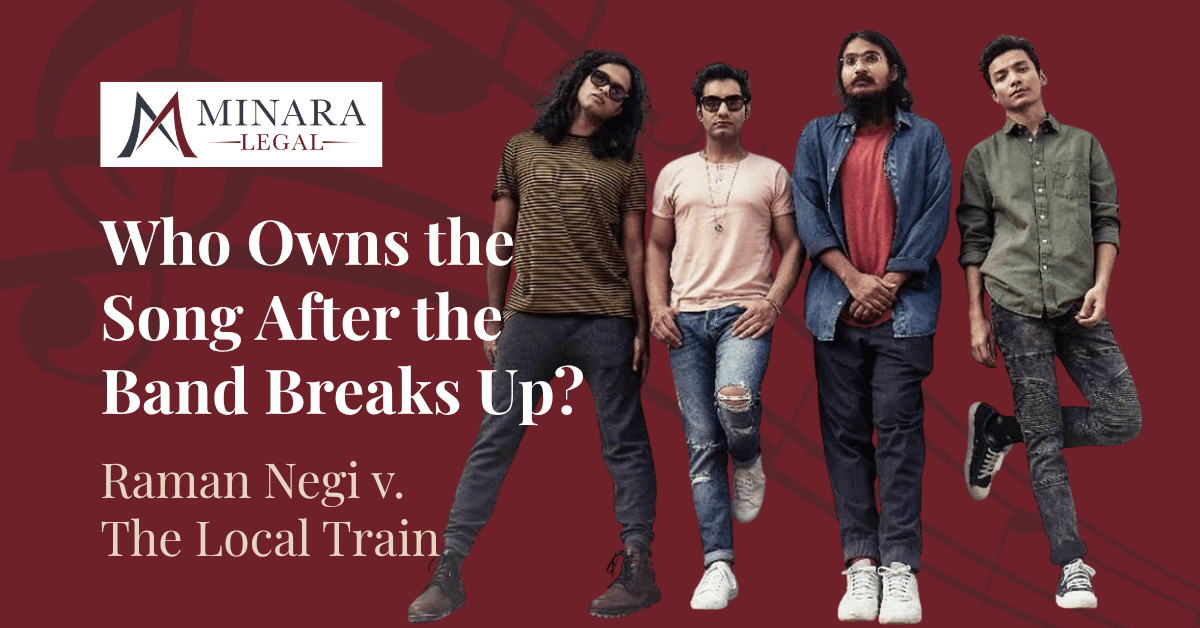
The dispute between Raman Negi, former frontman and co-founder of The Local Train, and his former bandmates before the Delhi High Court has triggered an important conversation around intellectual property rights in creative collaborations.
While the band’s popularity has brought the dispute into the public eye, the real significance of the case lies in the legal principles it engages—particularly those relating to copyright ownership, royalties, trademark rights, and the consequences of informal arrangements in the creative industry.
Background of the Dispute
Raman Negi exited The Local Train in 2021. Following his departure, the band continued to perform and commercially exploit songs written and composed by him. Negi approached the Delhi High Court alleging that his former bandmates were using his copyrighted works without permission and without paying his rightful share of earnings.
He claims sole authorship of lyrics and composition in several songs, including some of the band’s most successful tracks. The dispute is therefore not merely about unpaid royalties; it raises a foundational question: who owns creative works once a collaboration ends, and can those works be commercially exploited without consent or compensation?
Copyright Ownership and Authorship
Negi asserts sole authorship of lyrics for 15 tracks across the albums Aalas Ka Pedh (2015) and Vaaqif (2018), and sole musical composition for five songs, including Choo Lo, Aaoge Tum Kabhi, and Kaisey Jiyun. Several other songs, he claims, were either solely or jointly composed by him.
Under the Copyright Act, 1957, copyright initially vests in the author of the work:
- In literary works (lyrics), the lyricist is the author.
- In musical works (composition), the composer is the author.
- Performers enjoy separate performer’s rights independent of authorship.
Unless there exists a valid written assignment or licence, copyright ownership remains with the creator. Indian copyright law is explicit that assignments must be in writing and duly signed. Informal understandings, oral assurances, or industry practices cannot override statutory requirements.
This dispute reinforces a critical principle: being part of a band does not automatically make all members co-owners of every creative work.
Royalty Rights and Revenue Sharing
Royalty entitlement forms a central part of Negi’s claim. He alleges denial of royalties from live performances, streaming platforms, and other commercial exploitations, despite continued use of his works.
In his petition, Negi categorises the works as follows:
- Collaborative sound recordings and audiovisual works, with at least a 25% stake
- Independently authored literary works, with 100% ownership
- Jointly authored musical works, with an undivided 50% share
Under copyright law, an author’s exit from a collective does not extinguish royalty rights. These rights survive unless expressly assigned or waived. Courts often order an accounting of profits in such cases and assess whether continued exploitation without payment constitutes unjust enrichment.
Band Name, Trademark, and Goodwill
Beyond copyright, the dispute also touches upon trademark rights and goodwill associated with The Local Train. Band names function as commercial identifiers and may attract protection under the Trade Marks Act, 1999.
When a founding member exits, questions frequently arise regarding control over the brand and whether continued use misrepresents association with the original creator. Such situations may invoke the doctrine of passing off, particularly where public perception and goodwill are at stake.
The case illustrates that brand value in the creative industry is not merely reputational—it carries enforceable legal significance.
Absence of Exit Agreements
A recurring issue in creative collaborations is the lack of formal exit arrangements. Negi alleges that no comprehensive settlement was executed at the time of his departure to clarify ownership, royalties, or future use of works, despite repeated requests.
In the absence of contractual clarity, courts are often compelled to rely strictly on statutory provisions rather than inferred intent. This underscores the importance of exit clauses, buy-out mechanisms, and continuing royalty frameworks, especially where creative works generate long-term revenue.
Key Legal Takeaways
The dispute offers several broader lessons for creators and creative enterprises:
- Authorship is statutory, not sentimental; ownership flows from creative contribution, not group association.
- Collaboration does not amount to assignment; intellectual property rights must be expressly transferred through written agreements.
- Exit does not extinguish entitlement; royalty rights continue unless lawfully relinquished.
- Brand value is legally protectable; band names and goodwill attract trademark and passing-off protection.
- Preventive IPR documentation is indispensable; informal arrangements often culminate in costly litigation.
Conclusion
The Raman Negi dispute serves as a cautionary tale for India’s growing creative economy. It demonstrates that intellectual property rights outlive relationships, and that success often magnifies unresolved legal ambiguities.
As Indian courts continue to enforce statutory IPR protections with increasing rigour, creators and collaborators must move away from trust-based arrangements towards legally robust frameworks that clearly define ownership, royalties, and exit consequences.