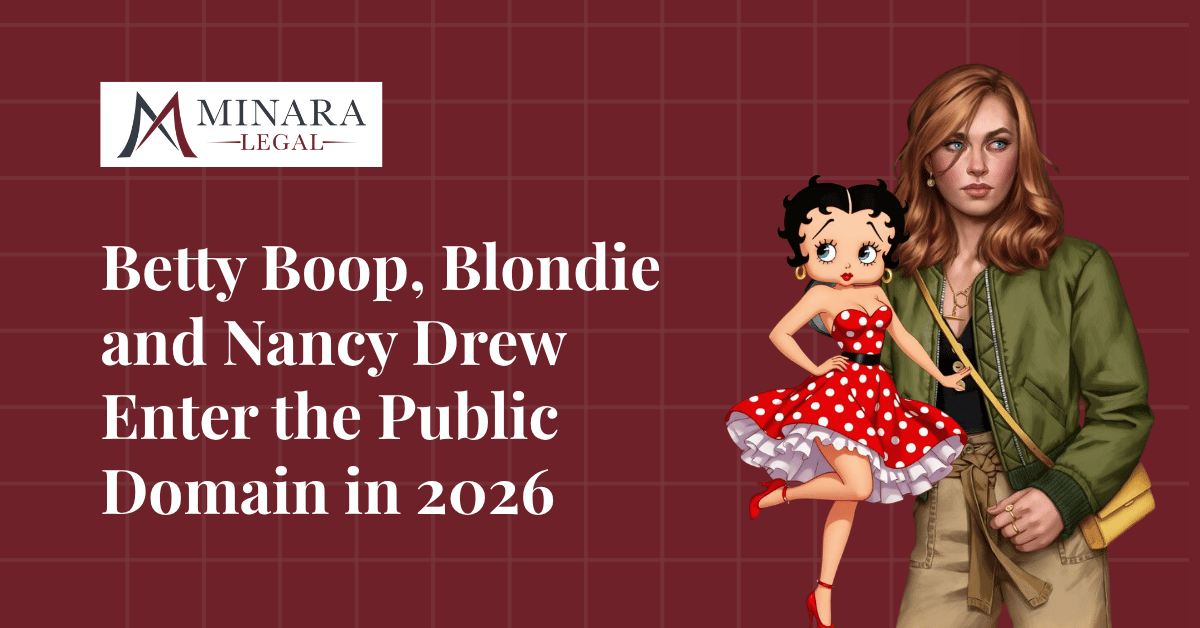
In U.S. copyright law, this date plays a crucial role: all works published before it are deemed to be in the public domain. In 2026, for example, that would be early 20th-century figures such as Nancy Drew and Blondie or Betty Boop (who have surpassed the current 95-year copyright limit). As the Associated Press and PBS NewsHour have explained, this moment is culturally potent, legally murky and commercially pivotal. Although creators are now free to re-use those figures without fear of modern-day lawsuits or requests for payment, they’re not totally out-of-date legally. Consumer protection laws, second-hand rights and trademark law still limit abuse. Illustrations by Stephen Haines for The New York Times Using Betty Boop, Nancy Drew and Blondie as case studies, this article explores what has fallen into the public domain, what is still protected and how courts have demarcated these lines.
I. The Significance of 2026: ‘End of the “Drought” ’
In the PBS story, Jennifer Jenkins, Director of Duke University’s Center for the Study of the Public Domain, notes that in this year-long release hiatus from 1925-2019 (due to several copyright extensions by Congress), millions of works told in thousands of books could have been reimagined and created.
Copyright protection was extended through the 1998 Sonny Bono Copyright Term Extension Act to:
- 95 years after works of corporate authorship are published
- 75 years for ‘works’ & 100 for individual works, the life+xx must have lapsed.
So on 1st January, 2026 works first published in 1930 entered public domain.
The law reflects a constitutional compromise:
- Temporary monopoly to encourage production
- Society’s long-term benefit of access to enriched knowledge and culture
The U.S. Supreme Court reaffirmed this balance in Eldred v. Ashcroft, 537 U.S. 186 (2003), by deciding that while Congress can extend copyright terms, entering the public domain is mandated by the Constitution.
II. Betty Boop: From Jazz-Age Flapper to Postfeminist Icon
A. The Surprising Story of Betty Boop, Alida Nugent is the author of four books and lives in Brooklyn.
As the PBS piece so eloquently details, Betty Boop was initially a dog.
She first appeared in the 1930 animated short “Dizzy Dishes” (which, along with three other Betty Boop cartoons is set to enter the public domain in 2026). In that debut:
- She had poodle ears and a black nose
- She was the sidekick to Bimbo, a dog with human appearance
- She was unnamed, singing “boop-boop-a-doop”
Betty would only fully metamorphosize into the human flapper icon that is plastered on every product, tattoed onto bodies world wide (go ahead; Google it) and referenced time again in pop culture.
B. The Present Pantheon
From 2026, these are the works that authors can already use however they want to:=
- The 1930 short “Dizzy Dishes”
- The dog-like Betty Boo from that movie
- The style of animation, dialogue, music and story in the work
This rule is in keeping with the principle set forth in Dastar Corp. v. Twentieth Century Fox Film Corp., 539 U.S. 23 (2003), that after a copyright expires, the work passes into the public domain, and it cannot subsequently be reclaimed through related forms of copyright mitigation.
C. What Is Not Free: Character Development and Trademark Law
The Betty Boop that is most familiar to most people — fully human, characterised and commercialised — was developed later in her story and those first works are still under copyright.
That characters change over time has been acknowledged by the courts, and later means of expression remain protected even when early ones enter the public domain.
In Warner Bros. Pictures v. CBS, 216 F.2d 945 (9th Cj’. 1954) (Speilberg J. presiding), the special master found that copyright only protects expressions of a character, not the abstract idea of a character.
Application to Betty Boop
You may use:
- The 1930 Betty Boop from Dizzy Dishes
You may not use:
- Visual traits introduced later
- Later narratives or catchphrases
- Modernized depictions still under copyright
D. The Trademark Obstacle: Fleischer Studios v. AVELA
The PBS piece does well to note a key caveat: copyright and trademark are different legal beasts.
This is precisely what the court did in Fleischer Studios, Inc. v. A.V.E.L.A., Inc., 654 F.3d 958 (9th Cir. 2011) (discussing that the defendant could argue its use was fair based on Betty Boop photos in public domain, but Fleischer Studios could still raise infringement of trademark claims because there use created “implied endorsement or source confusion”).
This theory is consistent with the concept or purpose of trademark law as a whole, the protection of consumers not authors.
III. Blondie: Legal Metamorphosis, Marriage, and The Funny Papers
Blondie Boopadoop, Chic..also features Young’s comic strip character that appeared in 1930 as a frivolous flapper.
The initial comic strips depicting her life before she married Dagwood Bumstead are now in the public domain.
But like Betty Boop:
- Character developments after marriage
- In later domestic comedy iterations
- Copyright and trademark still protect titles and branding, along with syndicated strip formats.
That public domain for the character is version-specific rather than system-wide underscores a theme in copyright law.
IV. Nancy Drew: The Girl Sleuth Drinks, Swears, and Solves Her First Real Case
A. The Nancy Drew Books of the 1930s and 1940s
The first four books in the Nancy Drew series were published by the Stratemeyer Syndicate in 1930, including “The Secret of the Old Clock,” by Mildred Benson under the pen name Carolyn Keene.
These four books are currently in the public domain, 2026.
This enables artists to utilize:
- The initial text
- Nancy Drew’s early portrayal
- But the stories and mysteries in those pieces
B. Layered Copyright and Derivative Work
The case of Nancy Drew serves as a prime example of estoicamente copyright protection for nesting dolls cut out.
The Supreme Court has said RW requires that derivative works are only protectable to the extent of their original contributions, see Stewart v. Abend, 495 U.S. 207 (1990).
Request to Nancy Drew
The public domain
- Characters and text from the original 1930.
Still safeguarded:
- Updated versions
- Contemporary modifications
- Later character traits and narrative arcs
C. Trademarks and Branding Risks
From a commercial standpoint, the Nancy Drew name is vital because it is associated with approved video games, TV shows and books.
Indeed, at one point in Universal City Studios v. Nintendo Co., 746 F.2d 112 (2d Cir., 1984), the law of trademark forbids uses that evoke a likelihood of confusion.
Nancy Drew in the Public Domain
Permissible Use:
- Print a facsimile or annotated edition of the original (1930) text of The Secret of the Old Clock.
Dangerous
- Advertise a new product as “The Official Nancy Drew Mystery Series” without authorization.
V. Key Legal Takeaways for Businesses and Creators
The emergence of Betty Boop or Nancy Drew in the public domain creates opportunity, though no immunity, from a law firm advisory perspective.
Lawful Use Checklist
- Find out what exact version is in the public domain.
- Avoid copyrighted content later on
- Perform trademark clearance.
- Make sure that there is nothing false or wrong with any claims or endorsements.
- Add something special for safety reasons
Conclusion
Asked about Nancy Drew, Blondie and Betty Boop marching into the public domain in 2026, Ladd was unfazed: “The process is doing what it’s supposed to do — allowing copyrighted works back into the public domain after a limited time, not locking them up forever.” The public domain is a valid legal matter, not a technicality, which gives and asks for the freedom of creativity. It’s a reminder that intellectual property law is concerned with finding the middle road between access and ownership. People like Nancy Drew and Betty Boop are in the public domain in 2026, no longer private property, transformed into a public patrimony subject to reimagining within reason.
References
- Dastar Corp. v. Twentieth Century Fox Film Corp., 539 U.S. 23 (2003)
- Eldred v. Ashcroft, 537 U.S. 186 (2003)
- Stewart v. Abend, 495 U.S. 207 (1990)
- Warner Bros. Pictures, Inc. v. Columbia Broad. Sys., Inc., 216 F.2d 945 (9th Cir. 1954)
- Fleischer Studios, Inc. v. A.V.E.L.A., Inc., 654 F.3d 958 (9th Cir. 2011)
- Universal City Studios, Inc. v. Nintendo Co., 746 F.2d 112 (2d Cir. 1984)
- Copyright Act of 1976, 17 U.S.C. §§ 101–810
- PBS NewsHour Article
- Duke Center for the Study of the Public Domain
- Duke Law School Article
- The Secret of the Old Clock (1930)
- The Maltese Falcon (1930)
- As I Lay Dying (1930)